x

Choose Country Code

x

Direction

x

Ask a Question

  • Ask a Question
  • Scan a Question
  • Post MCQ
  • Note: File extension must be of jpg, jpeg, png, bmp format and file size must not exceed 5 MB
x

Ask a Question

x

x
x
x
Hire a Tutor

Answers and Solutions

What's Your Question?
Answer

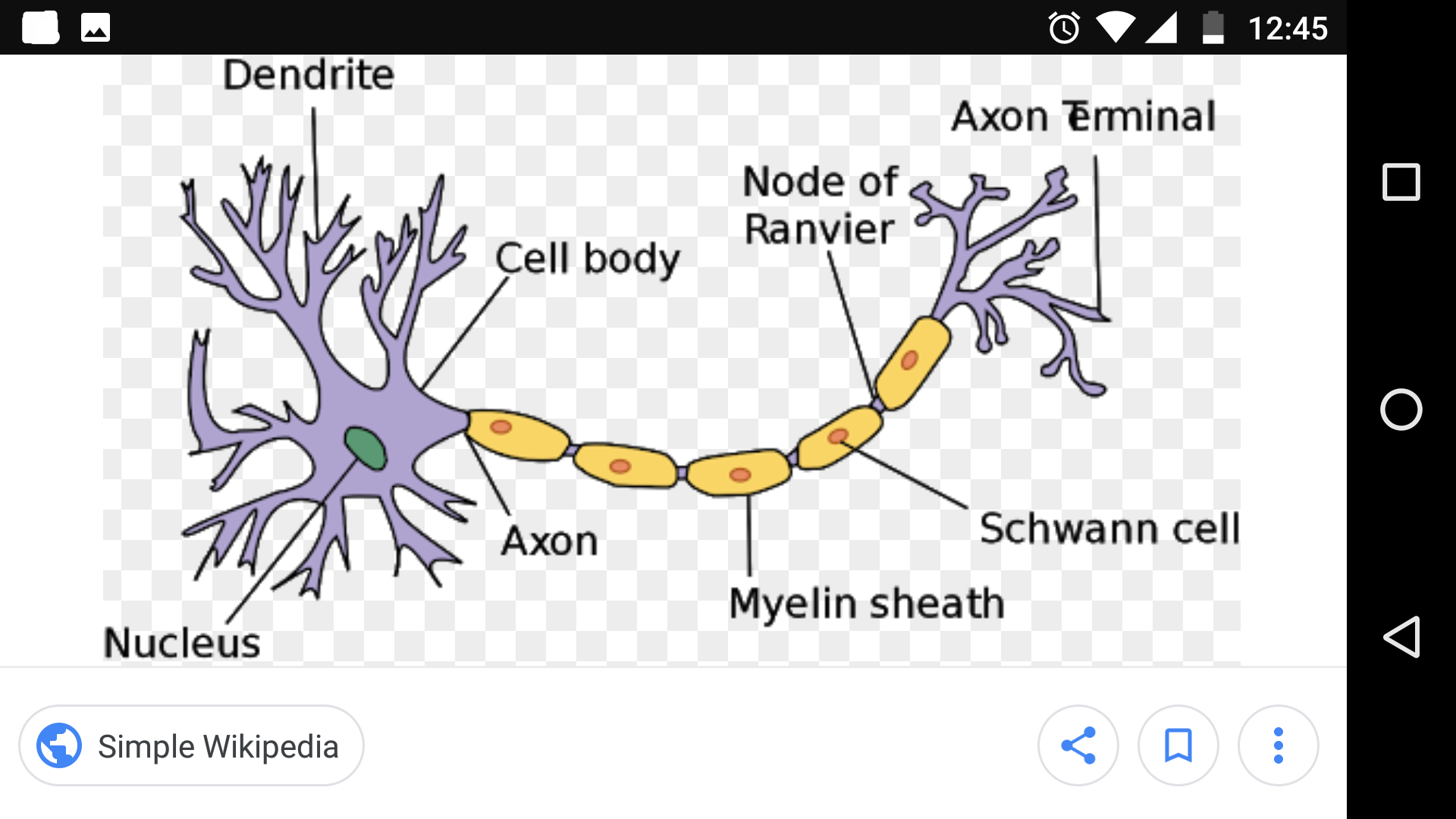
Dendrites are the branched projections of a neuron that act to propagate the electrochemical stimulation received from other neural cells to the cell body, or soma, of the neuron from which they project. Electrical stimulation is transmitted onto them by upstream neurons (usually their axons) via synapses which are located at various points throughout the dendritic tree.

Dendrites play a critical role in integrating these synaptic inputs and in determining the extent to which action potentials are produced by the neuron. Dendritic arborization, also known as dendritic branching, is a multi-step biological process by which neurons form new dendritic trees and branches to create new synapses.

  •  
Answer

A dendrite is a short, branched extension of a nerve cell. These are the parts of a neuron (nerve cell) responsible for receiving impulses transmitted from other cells through the synaptic cleft.

Answer

Dendrites are projections of a neuron (nerve cell) that receive signals (information) from other neurons.

Answer
Dendrites are protoplasmic protrusions that extrude from the cell body of a neuron
Answer
Projections from cyton of a neuron. Dendron branches into dendrites.
Answer
Branches structure of nerve cells
Answer

a short branched extension of a nerve cell, along which impulses received from other cells at synapses are transmitted to the cell body.

Answer

Dendrites are protoplasmic extensions of the cell body of a neuron. It helps in the transmision of the impluse from one nuron to the other. Dendrites may form dendritic branching.

Answer
Dendrites receive electric impulse or message or stimulus from another neurones. They are the projections on cyton.
Answer

Dendrites are projections of a neuron (nerve cell) that receive signals (information) from other neurons.

The transfer of information from one neuron to another is achieved through chemical signals and electric impulses, that is, electrochemical signals.The information transfer is usually received at the dendrites through chemical signals, then it travels to the cell body (soma), continues along the neuronal axon as electric impulses, and it is finally transferred onto the next neuron at the synapse, which is the place where the two neurons exchange information through chemical signals. At the synapse meet the end of one neuron and the beginning—the dendrites—of the other.

Answer

Dendrites are small arm like structure projecting out of a neuron. It consists most of the receptive surfaces on the neuron which enables it to connect with other neurons. The transfer of information from one neuron to another is achieved through chemical signals and electric impulses, that is, electrochemical signals. The information transfer is usually received at the dendrites through chemical signals, then it travels to the cell body (soma), continues along the neuronal axon as electric impulses, and it is finally transferred onto the next neuron at the synapse, which is the place where the two neurons exchange information through chemical signals. At the synapse  the end of one neuron meets the beginning dendrites of the other.

Post Answer and Earn Credit Points

Get 5 credit points for each correct answer. The best one gets 25 in all.

Post Answer